In post-election pieces attempting to determine the causes of GOP President-elect Donald Trump’s win, many commentators have drawn on white socioeconomic dysfunction or pain to dance around the stirrings of whites finding an identity. Trump’s bucking of Republican national election performance trends with success in the upper Midwest and even the northeast maps along the heroin deaths, the lower life expectancy, and even the lower fertility white populations in America.
Will there be a Trump baby boom?
It’s easy to laugh at the question, as there is no change to trends. Nothing culturally or socially has changed yet. Economic incentives have not been discussed much. As argued here at Social Matter by Joshua Still, throwing money at the low fertility problem is not an adequate solution. There is something deeper at play here, and not just re-orienting society to give women greater status for motherhood than careerism. Trump has no plans in the works that approach anything like the lavish benefits European nations are using to lure prospective parents.
How much do economic incentives matter? Maybe a touch on the margins as evidenced by the slight increases to fertility in different nations that have tackled the problem with social welfare programs.
But Trump baby boom pushers might have a case. Re-industrializing the forgotten areas of America will help some families in their quest for a second or third child. On the margins, how many whites have not had children or stopped at one because they want to afford to live in a good school district? Deportations and closing the immigration window could push up the white fertility rate in a reproductive sigh of relief that one’s English-speaking child will not be the minority in their school district in five or ten years.
There’s a historical reference here. Weimerica, the echo of Weimar Germany, can look at the past to see how pride in one’s identity and the struggle for greatness can boost family formation. Weimar Germany saw a decreasing, even plummeting fertility rate. The numbers are undeniable.

One thing to note is that while the German birth rate had decreased from the mid-19th century to 1914, the total number of surviving children had not changed much. German families had switched from having four children and two surviving to have slightly more than two and all children surviving. This varied by region, and with industrialization and urbanization, the total fertility rate dropped along with economic growth in cities.
After the Great War, soldiers came home and the total fertility rate rebounded to pre-war levels. This did not last long. Weimar Germany was plagued by communists revolutions, coups, and street fighting, in addition to disastrous economic processes like hyperinflation, war reparations, reparation negotiations, and efficiency demands. Weimar Germany also pushed through multiple social welfare policies, saw social mores and norms erode, and changed prostitution and abortion laws. In an era of neither economic, nor political security, the birth rate bottomed out and was at war-era levels by 1932.
Look at those links with births graphed again. Hitler comes to power and they immediately jump. No policies were enacted, no changes in the culture or social situation in 1933, and yet the jump is unmistakable. The Nazis would later go on to nudge women out of the workforce, encourage women to focus on family, and even award women medals for having four or more children. Note there was not just an award, but young men were to stop on the street and salute these mothers. It was public approval that granted positive status to these women and that role of motherhood. That award did not come into being until 1939, and we can see the change in birth rates already by the mid-’30s. The promise of a greater tomorrow, that belonged to them, was repeated over and over in media and speeches.
Skeptics could point out how there was no black baby boom with Obama’s victory in 2008, but his arrival was accompanied by our modern economic depression. In fact, all groups have seen fertility drops since 2008, similar to all groups rising after leaving the late ’70s-early ’80s peak abortion era. Abortion must have been the hot new thing for Boomer women to try just once, but the Reagan-era optimism could have affected all groups.
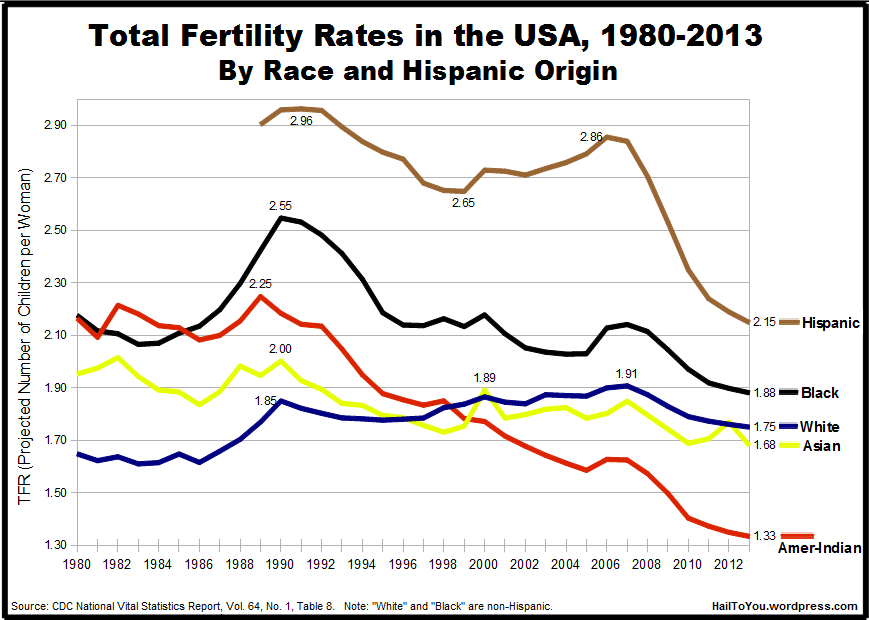
This is a Western problem, and implicit in that idea is a white problem. Trump’s civic nationalism is a call to all Americans to make America great again, but the reality of America is an empire of tribes competing for control of the state. Consider who spends all of their time hating America’s past versus waving flags? The civic messaging is reducible to a coded message to the tribe that still loves America. Trump’s victory and message is one of hope and a future worthy of America’s past achievements. On the margins, deportations, re-industrialization, and investment in our communities’ infrastructure could nudge enough Americans to not just have pride in their nation but consider it worthy enough to leave to their children.