In 2014, the paleoconservative luminary Pat Buchanan asked, “Will the U.S. become Balkanized?” For better or worse, the coming Second American Civil War or incipient Balkanization of the United States has been a common theme on the intellectual fringe with some spill-over in the mainstream. Everyone from black to white nationalists seems to be counting on some kind of spectacular political break-up in the next half-century, if not a profitable one then at least an apocalyptic one. Secession and segregation are integral parts of the vocabulary of American politics, and even some Hillary voters aren’t averse to asking Red Staters to just secede already and leave the good Blue States alone to enjoy their Starbucks-brand democratic socialism.
Such a flare-up would not be without precedent. The United States came asunder in 1861, so it is clearly not invincible, although the fault lines are almost certainly not the same. The ethnic, demographic, religious, economic, and geopolitical causes for the first American Civil War are not perfectly understood, but identifiable. Bloggers like JayMan have done an excellent job aggregating and explaining maps and data that show America’s different cultural streams, including the ones that went to war seventy years after independence from Britain. Here is a link to the ‘American Nations’ series, which will give you a basic rundown.
With the Republican frontrunner predicting riots, clever schemes to rework the political boundaries of the United States to reduce social tensions have been something of a fashion among aspiring thought criminals. There is the Six Californias proposal. The anarchists at the All Nations Party. Southern separatists who want the Old Confederacy back. Black separatists who want an African-American state in the Mississippi Delta or the Black Belt of the South. White separatists who want a white ethnostate in the Pacific Northwest (if nowhere else). Latino separatists trying to reclaim Aztlan. Libertarians want to move to New Hampshire and turn it into a small-government paradise, although most of them aren’t advocating open secession yet. Most aspiring separatists are gracious enough to offer Utah to the Mormons, and haven’t they pined for their Deseret long enough?
Despite widespread and increasing societal tension, the United States is simply not polarized enough to actually Balkanize or collapse into civil war. North America is becoming increasingly diverse and increasingly non-European, but diversity alone is not enough to drive a civil war or other major political rupture. For that, you need not just diversity, but concentrated diversity, and America’s diversity is deliberately diffused throughout the entire country.
Before Ukraine entered an official state of civil war in 2014, it had two clearly identifiable poles pulling the country East and West, respectively. Click here for a great map that illustrates what I’m talking about. In the West of Ukraine, the inhabitants spoke Ukrainian, wanted integration with the countries to the West in the EU and NATO, practiced Eastern Rite Catholicism on occasion, and had a history of being ruled by Poland, Lithuania, and Austria. In the East, the inhabitants spoke Russian, wanted re-integration with Russia, practiced Orthodox Christianity, and had no history except that of Russian conquerors and colonists in the territories around the Black Sea and Caucuses.

These cultural differences manifested in pre-Euromaidan presidential elections. Western regions voted upwards of 90%+ in favor of pro-Western candidates, while Eastern regions simultaneously voted 90%+ in favor of pro-Russian candidates. There was not much of a gradient either, as most regions voted 60-70%+ in favor of their particular candidate. The Donetsk region, which is now the core of the Russophone rebellion in Ukraine, voted for Viktor Yanukovych in 2004 with a margin of 96.2%. The Lviv region in the West (where half the population is Catholic) voted for Yanukovych’s opponent with a margin of 91.8%.
If you want to imagine an America that is going to split apart, imagine an America of 25 Utahs and 25 Hawaiis—but that is still not exactly as polarized as Ukraine was in 2014.
Take a look at this map of the results of the U.S. presidential election of 1860 one year before the Civil War began. Notice anything funny?
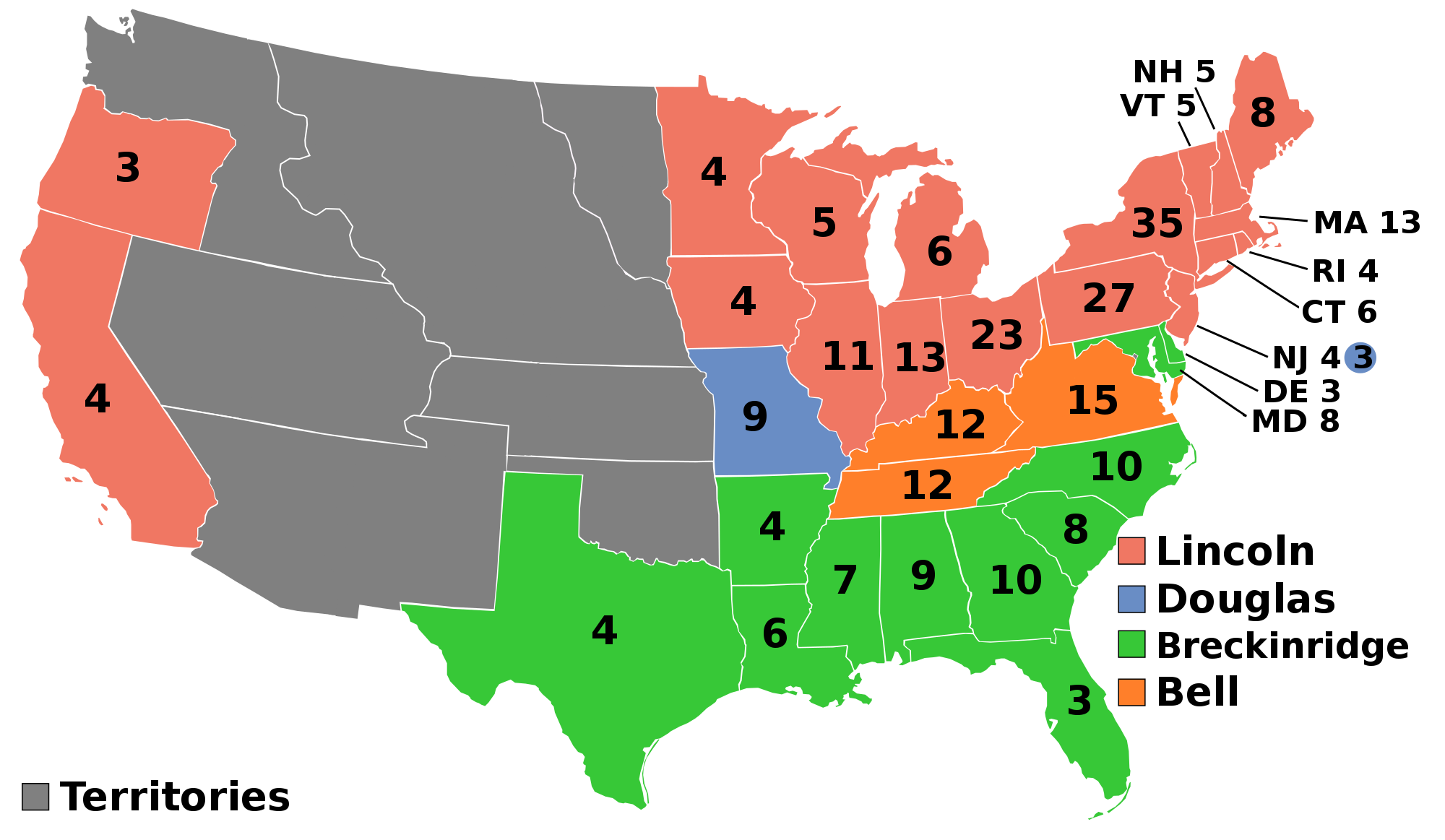
John C. Breckinridge, running on the ballot of the Southern Democratic Party, won almost the entire South, while Abraham Lincoln won almost the entire North and John Bell of the Constitutional Union ticket won three states in the center of the country, including Virginia, which coincidentally fell apart very soon. What were the victory margins then? Did they more closely approximate today’s American victory margins or the highly polarized margins in Ukraine?
Not a single ballot was cast in favor of Lincoln in 8 out of 10 states that Breckinridge won, and not a single ballot was cast in favor of Breckinridge in four Northern states, including the big ones of New York and Pennsylvania. The South had a three-way race between the Northern and Southern Democratic parties and the Constitutional Union Party, while the North had a two-way race between the Republican Party of Lincoln and the Northern Democratic party. The country was de facto holding two totally different elections. In other words, it was already de facto two different countries.
Looking at election results and JayMan’s extensive collection of maps showing regional dialects, climate, religion, etc., it is very difficult to discern any particular geographic poles that exist in contemporary America. There are certainly regional tendencies, but there is nothing that even comes close to approximating the level of polarization (bi- or multi-) necessary to catalyze a civil war like that of Ukraine in 2014 or the States in 1861. An election map of the United States reveals that America is not divided between Red and Blue, but is rather an almost continuous purple. The purported borders of cultural differences of America’s eleven nations are even more vague when examined on a map. Even a Mormon state is a bit far-fetched when only around half of Utah is Mormon.
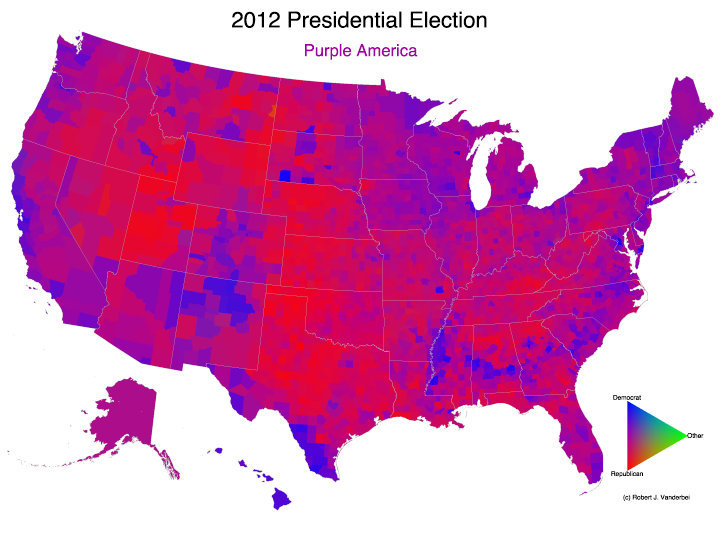
Ultimately, America cannot Balkanize because America’s diversity problem is not regional, but national and ubiquitous. The main political division in America is not geographic or territorial, but a caste division between Brahmins and Vaisyas. If the political turmoil in America worsens significantly, it is very unlikely to lead to secession, Balkanziation or civil war. The geographic conditions are simply not there. It is, however, very likely to lead to a patchwork of increasingly autonomous local governments—on the order of counties or municipalities—and widespread low-level political violence. At the moment, the United States seem destined to remain united even as they disintegrate.